
























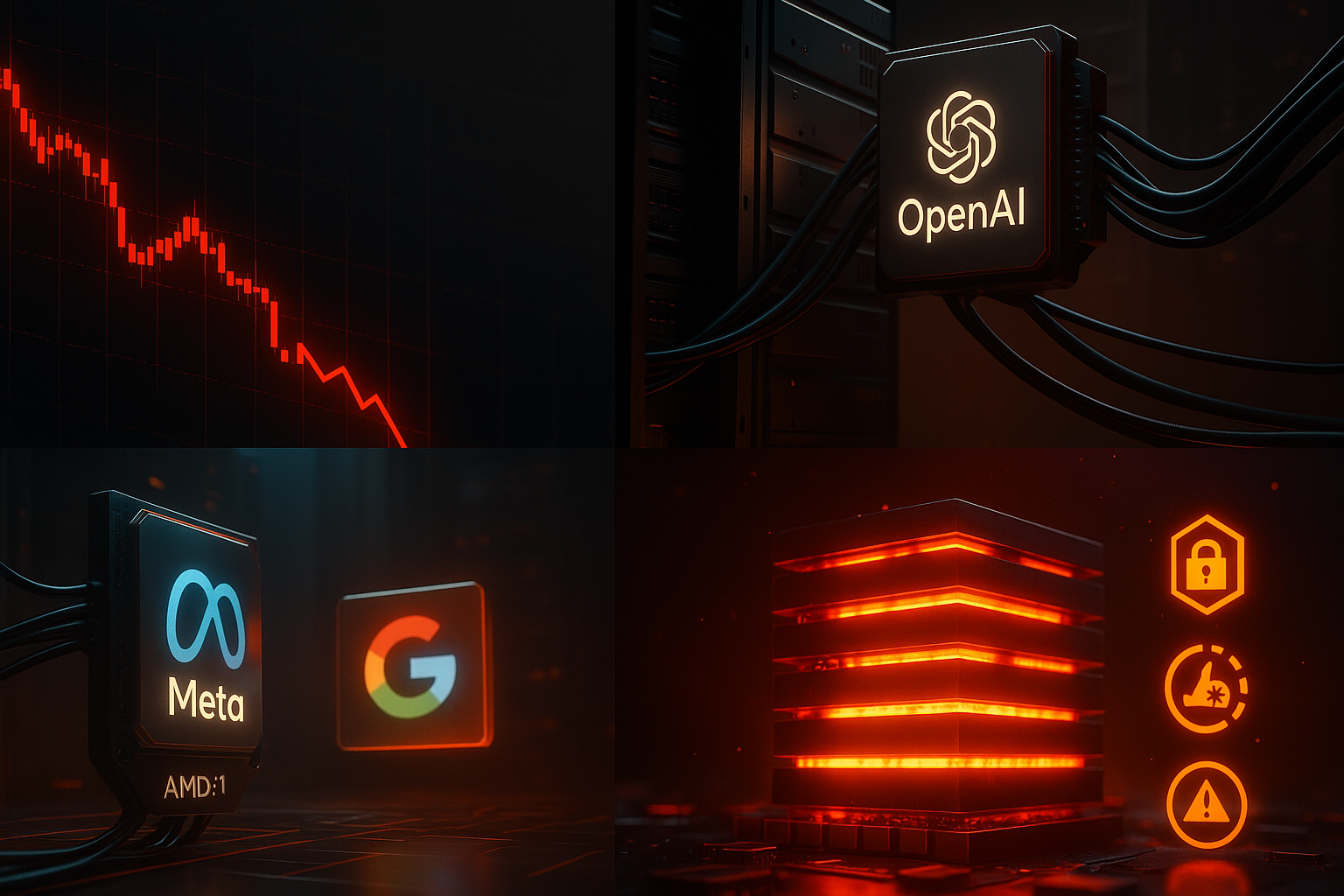
Advanced Micro Devices (NASDAQ: AMD stock) tanked hard in pre-market on Tuesday, wiping out weeks of AI momentum in a single session.
While the October OpenAI deal looked like a $100 billion-plus victory on the surface, the reality proved far grimmer: AMD is trapped in a dangerously uneven partnership with a single megacustomer holding lopsided leverage.
Meta’s bombshell pivot to Google chips exposed what Wall Street completely missed.
AMD handed over 160 million warrants at a penny while locking itself into OpenAI’s deployment pace, not its own growth targets.
The 160 million share warrant deal: How AMD became OpenAI’s banker, not partner
Here’s where the deal gets ugly. OpenAI snagged the right to buy up to 160 million AMD shares at one cent each, but with a catch that looks worse the closer you examine it.
Those warrants only vest when AMD hits a $600 share price and deploys one gigawatt by late 2026.
If things really click, OpenAI earns between two and ten per cent equity dilution across tranches stretching up to a $600 share price. It sounds aligned on paper. In reality, it’s a trap.
OpenAI now has absolutely zero reason to accelerate chip orders.
They’ve already locked in hardware pricing guarantees for years. AMD, by contrast, is completely tethered to OpenAI’s capex cycle.
When Meta announced its ditching of Nvidia chips for Google alternatives, it revealed the brutal truth hiding underneath AMD’s growth story.
AMD pulls in $4.3 billion in data centre revenue annually, but the concentration is terrifying.
If Meta, Microsoft, and others start diversifying their chip purchases, AMD’s sixty per cent data centre CAGR targets evaporate instantly.
The warrant structure actually incentivises OpenAI to milk existing deployments rather than expand faster, which is exactly backward from what AMD needs to justify valuations.
AMD stock: The crisis no one’s talking about
AMD’s gross margin sits around 52 per cent, but that masks a profitability time bomb ticking underneath.
HBM memory costs eight to twelve times what standard DRAM runs, and that’s eating directly into the bottom line.
Samsung, SK Hynix, and Micron control HBM supply. With eighteen per cent of memory revenue now tied to HBM3E, capacity is stretched razor-thin.
Q3 warnings were already flashing red, margins technically expanded year-over-year, but export controls and component shortages were already squeezing hard.
If HBM suppliers jack up prices heading into the post-Thanksgiving crunch, AMD’s already-slim GPU margins will compress fast.
Nvidia has way better negotiating leverage with TSMC; AMD is getting squeezed in the middle.
Tuesday’s selloff priced all this in. Investors figured out that margin expansion hopes are vaporising while customer concentration risk balloons exponentially.
The warrant deal looked transformative three weeks ago. Today, it looks like a lifeline thrown to a sinking ship, and AMD just realised who’s really holding the rope.
The post Why AMD stock is crashing: the OpenAI monopoly trap that Wall Street ignored appeared first on Invezz